Monolith vs. Microservices: What Should You Choose First?
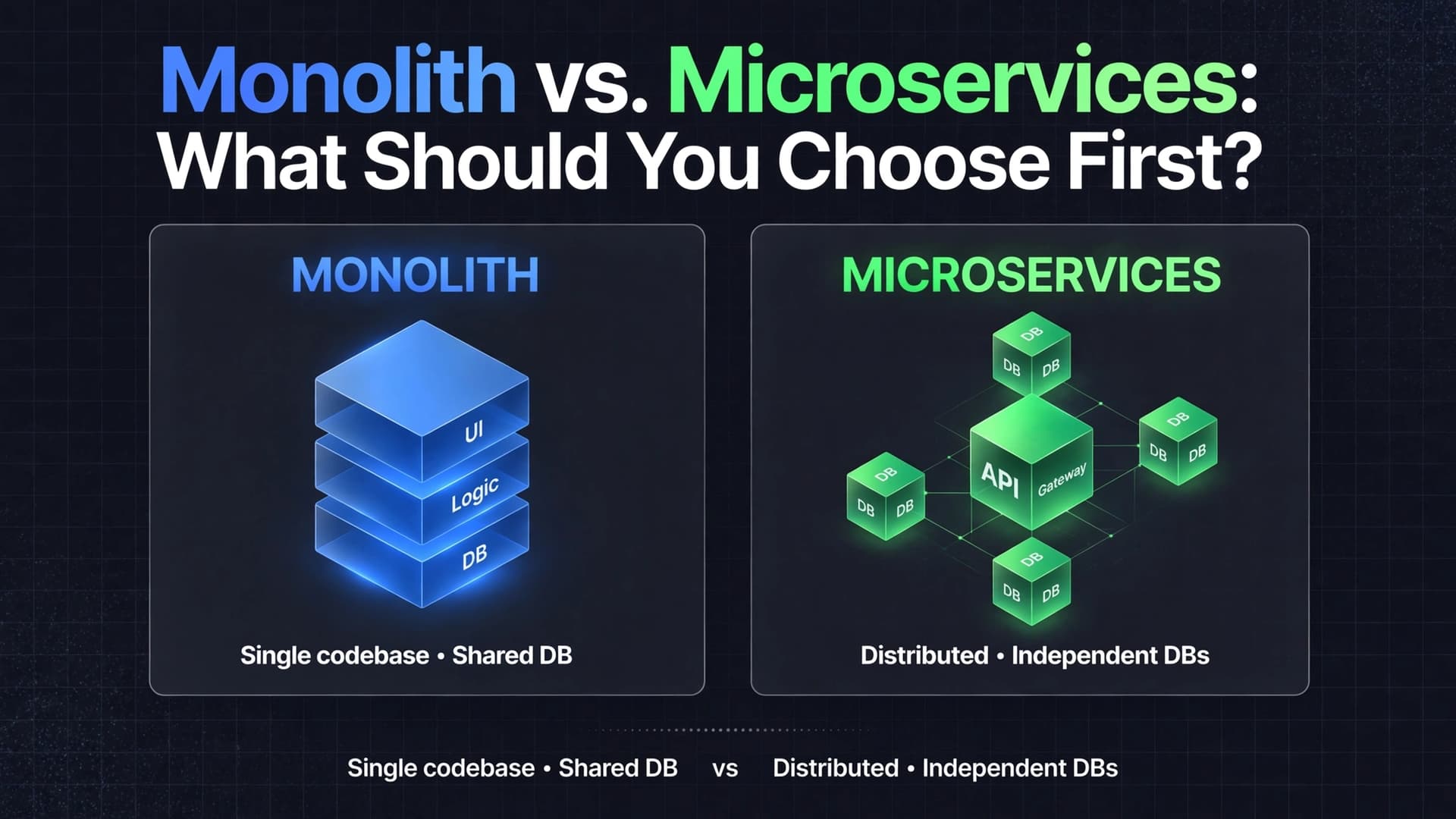
Monolith vs. Microservices: What Should You Choose First?
When building a backend application, one of the earliest architectural decisions is how to organize the application as it grows.
Should you build one application that contains all your features, or split those features into multiple independent services?
This is the difference between a monolithic architecture and a microservices architecture.
Both approaches are used in production. Neither is automatically better than the other. The right choice depends on your application's requirements, your team's experience, and the complexity you are prepared to manage.
In this article, we will understand both architectures, compare their trade-offs, and explore when it makes sense to move from a monolith to microservices.
1. What Is a Monolithic Architecture?
A monolithic architecture organizes an application as a single deployable unit.
The application may contain multiple modules, such as authentication, users, products, orders, and payments, but those modules run as part of the same application deployment.
For example, an e-commerce backend might contain:
- Authentication and user management.
- Product management.
- Shopping cart functionality.
- Order processing.
- Payment integration.
In a monolithic application, these features can live in one codebase and be deployed together.
Monolithic architecture
                  Client
                    |
                    v
              Backend API
                    |
          +---------+---------+
          |         |         |
          v         v         v
       Users     Products   Orders
          |         |         |
          +---------+---------+
                    |
                    v
                 Database
This diagram represents a simplified logical structure. In a real application, modules may share infrastructure, and the application may run multiple identical instances behind a load balancer.
Why developers choose monoliths
A monolith is often easier to start with because:
- The application has a straightforward deployment process.
- Modules can communicate through ordinary function calls.
- Local development and debugging are relatively simple.
- Transactions across related data can be easier to manage.
- Fewer distributed-system components are required.
A monolith does not have to mean poorly organized code. A well-structured monolith can separate features into clear modules while keeping them within one deployable application.
2. What Is a Microservices Architecture?
Microservices architecture divides an application into smaller services that can be developed, deployed, and operated independently.
Each service owns a specific business capability and communicates with other services through defined interfaces, such as HTTP APIs or messaging systems.
For example, an e-commerce application might have separate services for:
- User accounts.
- Product catalogs.
- Orders.
- Payments.
- Notifications.
Microservices architecture
                       Client
                         |
                         v
                    API Gateway
                         |
          +--------------+--------------+
          |              |              |
          v              v              v
     User Service   Product Service   Order Service
          |              |              |
          v              v              v
      User Data      Product Data      Order Data
                                         |
                                         v
                                  Payment Service
                                         |
                                         v
                                    Payment Data
This is a conceptual illustration, not a requirement that every microservice must have its own database. However, services should have clear data ownership rather than freely sharing and modifying one another's internal tables.
Microservices introduce independent deployment and scaling possibilities, but they also introduce network communication, service failures, observability requirements, and additional operational work.
3. Monolith vs. Microservices: The Main Differences
| Aspect | Monolith | Microservices |
|---|---|---|
| Deployment | Application deployed as one unit | Services deployed independently |
| Code organization | One application codebase is common | Multiple service codebases or projects are common |
| Communication | Often direct function calls | Often HTTP, RPC, or messaging |
| Scaling | Usually scales the application as a whole | Individual services can scale independently |
| Debugging | Often simpler within one process | May require tracing requests across services |
| Data management | Shared database is common | Services should own their data boundaries |
| Infrastructure | Generally simpler | Usually more operationally demanding |
| Failure handling | Internal failures may affect the application | Service failures can affect dependent services |
| Team structure | Works well with smaller teams | Can support multiple independent teams |
| Initial development | Often faster | More setup and coordination are required |
These are common tendencies, not absolute rules. A monolith can have multiple teams and instances, while a poorly designed microservices system can be tightly coupled despite having many services.
4. Understand the Difference Through an Example
Imagine you are building a college ERP application.
It needs:
- Student login.
- Attendance management.
- Fee payments.
- Course management.
- Notifications.
Option A: Build a monolith
You create one backend application with separate modules for each feature.
college-erp/
├── src/
│   ├── modules/
│   │   ├── auth/
│   │   ├── students/
│   │   ├── attendance/
│   │   ├── payments/
│   │   ├── courses/
│   │   └── notifications/
│   ├── config/
│   ├── middleware/
│   ├── app.js
│   └── server.js
├── tests/
├── package.json
└── README.md
The folders are organized by responsibility, but the application can still be built and deployed as one unit.
This is a modular monolith: one deployable application with clearly separated internal modules.
It is often a practical choice for a student project or a small team because you can focus on implementing the actual features instead of managing distributed infrastructure.
Option B: Build microservices
You split the ERP into independently deployed applications.
college-erp/
├── services/
│   ├── auth-service/
│   ├── attendance-service/
│   ├── payment-service/
│   ├── course-service/
│   └── notification-service/
├── gateway/
├── infrastructure/
└── documentation/
Each service may have its own source code, configuration, tests, deployment pipeline, and data ownership rules.
Now you must also consider:
- How services authenticate requests from one another.
- What happens when a service is unavailable.
- How payment and attendance workflows coordinate.
- How API contracts remain compatible.
- How logs and traces are collected across services.
- How data consistency is maintained across service boundaries.
You have gained deployment flexibility, but you have also introduced more things that can fail.
The important lesson: Splitting an application into more services does not automatically make it more scalable or maintainable.
5. What Does Independent Scaling Actually Mean?
Suppose your ERP application experiences heavy traffic during attendance marking, while the course management feature receives relatively few requests.
With a traditional monolith, you might run more instances of the entire backend application to handle the extra load.
With microservices, you could scale the attendance service independently while leaving the course service at its normal capacity.
For example:
Monolith

1 application
      |
      v
Scale the whole applicationMicroservices
Attendance Service ---> More instances
Course Service ---> Normal instances
Payment Service ---> Scale as neededIndependent scaling can reduce resource waste when workloads differ significantly.
However, it is useful only when the services can actually be scaled independently and their dependencies, database capacity, and communication patterns do not become bottlenecks.
For a small application with moderate traffic, scaling a monolith horizontally behind a load balancer may be sufficient.
6. The Hidden Cost of Microservices
Microservices are often presented as the natural next step for a growing application. But each additional service introduces operational responsibilities.
Network communication
In a monolith, one module can call another module directly.
In microservices, a service may need to make an HTTP or RPC request to another service. Network requests can time out, fail, or take longer than expected.
Your application must handle those possibilities.
Distributed data
Suppose an order service creates an order and then requests payment from a payment service.
What happens if the order is created successfully but the payment service becomes unavailable?
You need a deliberate workflow for pending payments, retries, failed transactions, and reconciliation.
A database transaction within one service cannot automatically guarantee an atomic transaction across multiple independent services.
Monitoring and debugging
A single user request may pass through several services before a response is returned.
Without centralized logs, metrics, and distributed tracing, finding the source of a failure can become difficult.
Deployment complexity
Instead of deploying one application, you may need to manage multiple services, service configurations, secrets, health checks, network policies, and deployment pipelines.
Containers and orchestration tools can help, but they do not remove the need to understand the system.
Microservices are not inherently wrong. Their benefits need to justify these costs.
7. Does a Monolith Become a Bottleneck as It Grows?
Not necessarily.
A common misconception is that monolithic applications cannot scale.
A monolith can be deployed across multiple instances, placed behind a load balancer, optimized with caching, and supported by database indexing and query improvements.
For many applications, these techniques provide enough capacity without splitting the codebase into separate services.
The real challenge often comes from poor internal boundaries rather than the monolithic deployment model itself.
Warning signs may include:
- Modules depending heavily on one another's internal implementation.
- Changes to one feature repeatedly breaking unrelated features.
- Different teams frequently blocking one another.
- One workload needing substantially different scaling characteristics.
- Deployment requirements that genuinely conflict across parts of the system.
Even then, first identify the actual bottleneck.
A slow database query will not become faster merely because you move it into a microservice.
8. What Is a Modular Monolith?
A modular monolith combines the simplicity of a single deployment with clear internal boundaries.
Instead of allowing every module to access every other module's internals, each module exposes a defined interface.
For example:
Monolithic Application
|
+-- Auth Module
|   +-- Login
|   +-- Registration
|
+-- Attendance Module
|   +-- Mark Attendance
|   +-- Attendance Reports
|
+-- Payment Module
    +-- Create Payment
    +-- Verify Payment
The modules run inside one application, but their responsibilities remain separate.
A useful modular monolith should have:
- Clear ownership of business logic.
- Controlled dependencies between modules.
- Well-defined interfaces.
- Tests for important business rules.
- Limited access to another module's internal data and implementation.
This structure makes the application easier to maintain today and can make future extraction of a service easier if a genuine need appears.
It does not guarantee an effortless migration, but it reduces unnecessary coupling.
9. When Should You Choose a Monolith?
A monolith is usually a strong starting point when:
- You are building an MVP or a new product.
- Your team is small.
- Requirements are still changing frequently.
- You want a straightforward deployment process.
- Most features can share the same runtime and scaling strategy.
- You do not yet have evidence that independent services are necessary.
For a student project, portfolio application, startup MVP, or small business backend, a modular monolith is often a sensible default.
It allows you to spend more time learning the domain, building features, testing behavior, and delivering value.
You can still use Docker, CI/CD, a reverse proxy, a load balancer, and cloud infrastructure with a monolith.
Choosing a monolith does not mean avoiding modern development practices.
10. When Should You Consider Microservices?
Microservices become more attractive when the application has concrete needs that a single deployable unit makes difficult to satisfy.
Consider them when:
- Different business capabilities need independent deployment.
- Multiple teams need clear ownership of separate services.
- Specific workloads need independent scaling.
- Parts of the application require different technology or runtime characteristics.
- A failure in one capability needs stronger isolation.
- The organization can support distributed monitoring, deployment, and incident response.
These are signals to investigate microservices, not a checklist that must automatically trigger a migration.
For example, a notification service might be a good candidate for extraction if it has a distinct workload, can operate through a well-defined interface, and can tolerate asynchronous processing.
But extracting it simply because the application has reached a particular number of users or lines of code is not a reliable architectural decision.
11. How Do You Move from a Monolith to Microservices?
If you eventually need microservices, you do not necessarily have to rewrite the entire application.
A gradual approach is often safer.
Step 1: Identify a real problem
Find the capability causing the greatest deployment, scaling, reliability, or team-coordination difficulty.
Do not begin by splitting every module.
Step 2: Define a clear boundary
Choose a business capability with well-understood responsibilities.
For example, notifications may have clearer boundaries than a tightly connected workflow involving orders, inventory, and payments.
Step 3: Define the service contract
Decide how other parts of the application will interact with the new service.
Use an explicit API or messaging contract rather than allowing consumers to depend on internal implementation details.
Step 4: Establish data ownership
Decide which service owns the relevant data and how other services obtain it.
Avoid allowing multiple services to write directly to the same tables without a clear ownership and consistency strategy.
Step 5: Add operational support
Prepare health checks, logs, metrics, tracing, security, deployment automation, and failure-handling strategies.
A service is not production-ready just because it has its own repository or container.
Step 6: Migrate incrementally
Move one capability, validate the new design, measure its impact, and address problems before extracting additional services.
This gradual approach is often associated with the Strangler Fig pattern, in which new functionality progressively replaces parts of an existing system.
12. Common Architecture Mistakes
Mistake 1: Choosing microservices because they are popular
An architecture should solve a real problem, not simply match current industry trends.
Mistake 2: Treating every folder as a potential service
A folder or module is not automatically a good service boundary. Services should reflect meaningful business responsibilities and independent operational needs.
Mistake 3: Sharing one database without clear ownership
If every service directly modifies every table, the system can become tightly coupled despite having multiple deployments.
Mistake 4: Ignoring network failures
Service-to-service requests can fail independently. Timeouts, retries, idempotency, and appropriate failure handling are essential.
Mistake 5: Splitting too early
Prematurely distributed architecture can consume time that would be better spent improving the product and understanding its actual requirements.
Mistake 6: Assuming migration is easy
Extracting a service may require changing data ownership, API contracts, deployment workflows, and consistency guarantees. It is a substantial engineering task, not merely moving files.
13. A Simple Decision Framework
Before selecting an architecture, ask these questions:
| Question | If the answer is yes |
|---|---|
| Is the product new and still changing rapidly? | Start with a modular monolith |
| Is the team small or inexperienced with distributed systems? | Prefer the simpler deployment model |
| Can the application scale adequately as one unit? | A monolith may be sufficient |
| Do specific capabilities need genuinely independent deployments? | Evaluate service boundaries |
| Do workloads have substantially different scaling needs? | Consider independent services |
| Can the team operate distributed infrastructure reliably? | Microservices may be practical if other benefits justify them |
There is no universal user-count threshold, traffic number, or codebase size at which microservices suddenly become the correct choice.
The decision should be based on measured constraints and organizational needs.
Conclusion
Monoliths and microservices are different ways to organize and operate software. A monolith keeps an application within one deployable unit, while microservices divide business capabilities into independently deployable services.
A monolith is often simpler to develop, test, deploy, and operate. Microservices can provide independent scaling, deployment flexibility, and clearer ownership across teams, but they introduce distributed-system complexity.
For most new projects, starting with a well-structured modular monolith is a practical choice. Build clear boundaries, measure real bottlenecks, and introduce independent services only when their benefits justify the additional complexity.
Remember: Start with the simplest architecture that meets your requirements. Add complexity when the problem demands it, not before.