WebSockets vs. REST APIs: Understanding the Difference
WebSockets vs. REST APIs: Understanding the Difference
Imagine building a trading application where prices change every second.
If the frontend needs updated prices, should it repeatedly request data from the backend, or should the backend send updates as they happen?
This is where understanding REST APIs and WebSockets becomes important.
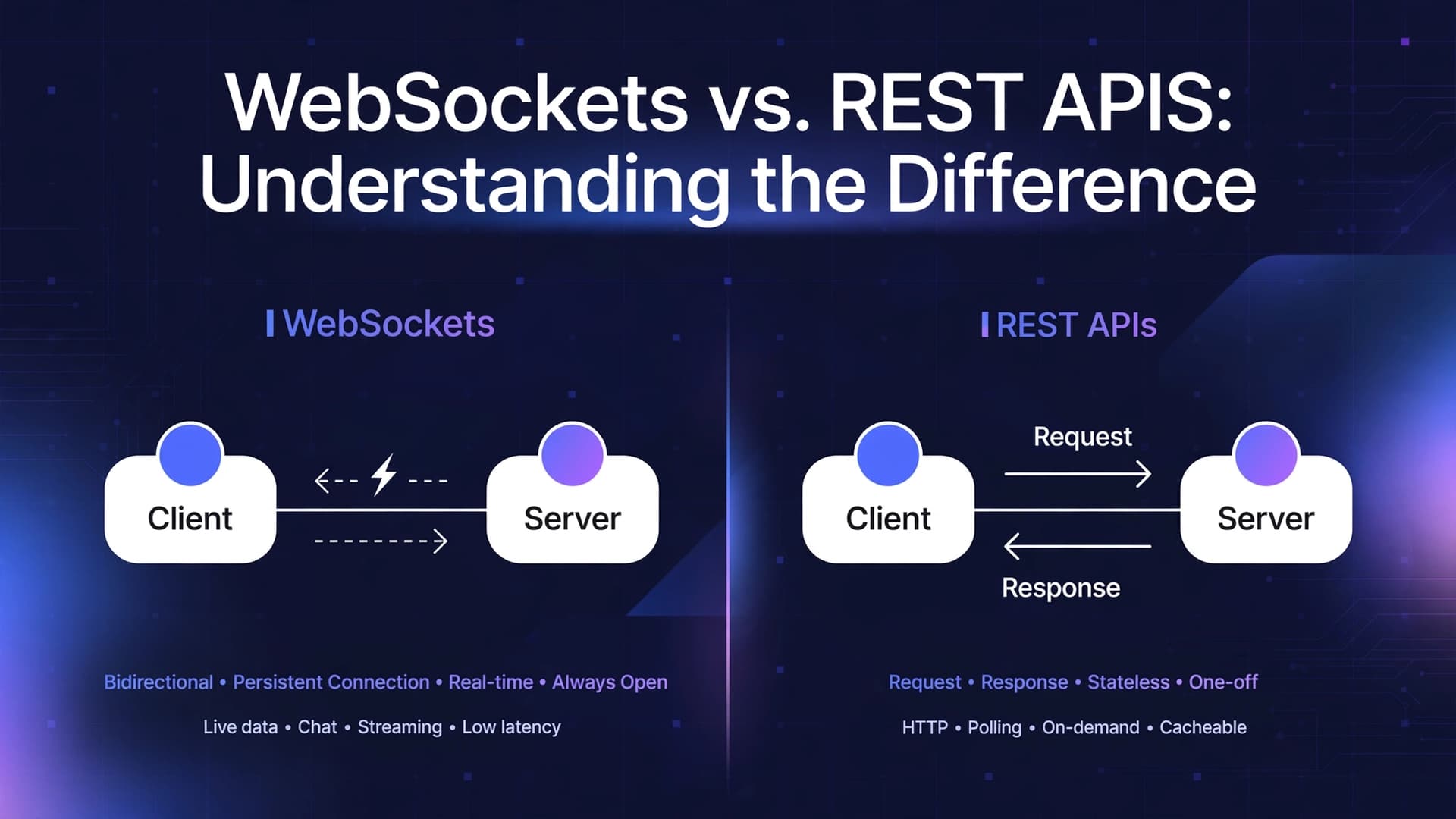
REST is commonly used for request-response communication, while WebSockets enable ongoing, bidirectional communication over a persistent connection.
Both are useful in modern applications. The key is understanding which communication pattern fits the problem you're solving.
1. What Is a REST API?
REST is an architectural style for designing networked applications.
In a typical REST API, a client sends an HTTP request to a server, and the server returns a response.
For example, a frontend might request a user's profile:
GET /api/users/42The server processes the request and returns a response:
{
  "id": 42,
  "name": "Manjit",
  "role": "developer"
}
The client can then display this information.
Common HTTP methods include:
GET— retrieve a resource.POST— create a resource or trigger an operation.PUT— replace a resource.PATCH— partially update a resource.DELETE— delete a resource.
REST APIs are widely used for authentication, user profiles, product listings, order management, and many other application features.
How REST communication works
Client
  |
  | HTTP Request
  v
Server
  |
  | Process Request
  v
HTTP Response
  |
  v
Client
The client initiates each request. The server normally responds to that request and finishes the exchange.
HTTP also supports persistent connections and other advanced features, but ordinary REST API interactions are generally designed around individual request-response operations.
2. What Are WebSockets?
WebSockets provide a communication protocol that allows a client and server to exchange messages over a persistent connection.
After establishing the connection, either side can send messages without initiating a completely new application-level request for every update.
For example, a server can send a new stock price to a connected client as soon as the update becomes available.
Typical WebSocket use cases include:
- Real-time chat applications.
- Live notifications.
- Collaborative editing.
- Multiplayer games.
- Live dashboards.
- Real-time trading interfaces.
How WebSocket communication works
Client                    Server
  |                          |
  | ---- Connection Setup -->|
  |                          |
  | <==== Persistent ========>|
  |        Connection        |
  |                          |
  | <------ Update ----------|
  |                          |
  | ------ Message --------->|
  |                          |
  | <------ Update ----------|
Unlike ordinary request-response interactions, both sides can initiate message transmission while the connection remains open.
WebSockets commonly begin with an HTTP handshake and then upgrade to the WebSocket protocol.
Secure WebSocket connections use wss://, while unencrypted connections use ws://.
3. REST vs. WebSockets
| Feature | REST APIs | WebSockets |
|---|---|---|
| Communication | Request-response | Bidirectional messaging |
| Connection | Requests use HTTP connections | Persistent connection after handshake |
| Server-initiated updates | Requires another mechanism or client request in typical setups | Supported directly |
| Typical use | CRUD operations and resource access | Real-time events and interactive features |
| Infrastructure | Common HTTP tooling and caching | Connection management and messaging infrastructure |
| Scaling concerns | Request throughput and statelessness | Connection counts, routing, and message delivery |
| Data format | Often JSON | Text or binary messages |
| Best fit | Operations initiated by clients | Continuous or event-driven communication |
Neither technology is universally better.
REST is often simpler for conventional application operations. WebSockets are useful when continuous, low-latency communication is a core requirement.
4. When Should You Use REST?
Consider an application with user accounts, products, and orders.
The frontend might need to:
- Register a user.
- Log in.
- Fetch a product list.
- Update a profile.
- Create an order.
- Retrieve order history.
These operations naturally fit request-response communication.
For example:
const response = await fetch("/api/products");

if (!response.ok) {
  throw new Error("Failed to fetch products");
}

const products = await response.json();

console.log(products);
The client requests the products, waits for the response, and processes the returned data.
REST is a good choice when the client needs a specific resource or wants to perform a discrete operation.
It also works well with established HTTP authentication, caching, monitoring, and API tooling.
5. When Should You Use WebSockets?
Now imagine the same application has a live activity dashboard.
Users want to see new events as they happen without repeatedly refreshing the page.
A WebSocket connection can deliver updates as the server receives them.
For example, using the browser's native WebSocket API:
const socket = new WebSocket("wss://example.com/ws");

socket.addEventListener("open", () => {
  console.log("Connected to the server");
});

socket.addEventListener("message", (event) => {
  const data = JSON.parse(event.data);

  console.log("Received update:", data);
});

socket.addEventListener("close", () => {
  console.log("Connection closed");
});

socket.addEventListener("error", (error) => {
  console.error("WebSocket error:", error);
});
This is a simplified client example. A production application also needs reconnection handling, authentication, message validation, and appropriate error recovery.
WebSockets are particularly useful when updates arrive frequently or when both client and server need to exchange messages independently.
However, a persistent connection introduces additional responsibilities, including connection lifecycle management and handling disconnected clients.
6. Can You Use Both REST and WebSockets?
Absolutely.
In fact, combining them is often a good architectural choice.
Consider a trading application.
REST can handle:
- User authentication.
- Fetching account details.
- Loading historical prices.
- Retrieving transaction history.
- Submitting an order.
WebSockets can handle:
- Live price updates.
- Real-time order status events.
- Market activity notifications.
- Live portfolio updates.
A simplified architecture might look like this:
                Frontend
               /        \
              v          v
         REST API     WebSocket
              |          |
              v          v
          Backend Services
                 |
                 v
              Database
The REST API handles operations that request or modify resources. The WebSocket connection delivers relevant events to connected clients.
This separation allows each communication mechanism to serve the purpose it handles best.
7. What About Polling and Server-Sent Events?
WebSockets are not the only way to receive server updates.
Polling
With polling, the client sends requests at regular intervals.
For example, a dashboard might request new data every five seconds.
Polling is straightforward to implement, but frequent requests can create unnecessary traffic when little or nothing has changed.
Server-Sent Events (SSE)
SSE lets a server stream events to a client over an HTTP connection.
It is useful when updates primarily flow in one direction: from server to client.
Examples include live logs, progress updates, and notification feeds.
Choosing between them
- REST: Fetch or modify resources on demand.
- Polling: Check periodically for new information.
- SSE: Stream server-to-client events.
- WebSockets: Exchange messages in both directions over a persistent connection.
The simplest solution that meets the application's requirements is usually the best starting point.
8. Challenges of WebSockets in Production
WebSockets introduce some considerations that developers should understand before deploying them at scale.
Connection management
The server must handle connections opening, closing, and unexpectedly disconnecting.
Clients may need reconnection logic with exponential backoff to avoid overwhelming the server after an outage.
Authentication and authorization
A successful connection does not automatically mean a user should receive every event.
The server must authenticate clients and verify that they are authorized to subscribe to particular resources or channels.
Scaling across multiple instances
Suppose a WebSocket client connects to server instance A, but an event is generated by instance B.
The application needs a mechanism to distribute that event to the instance responsible for the connected client.
Depending on the architecture, this might involve Redis Pub/Sub, a message broker, or another event-distribution system.
Adding a message broker does not automatically guarantee delivery. Delivery guarantees, retries, ordering, and duplicate handling depend on the system you choose.
Heartbeats and stale connections
Networks can fail without a clean connection closure.
Heartbeat mechanisms and appropriate timeouts can help identify connections that are no longer healthy.
Backpressure
A client may receive messages more slowly than the server produces them.
Applications should consider buffering limits, message coalescing, dropping obsolete updates where appropriate, and disconnecting clients that cannot keep up.
9. Common Mistakes to Avoid
Using WebSockets for everything
Not every feature requires real-time communication. A profile page usually does not need a persistent connection just to retrieve user information.
Repeatedly polling for high-frequency updates
Polling can be reasonable for infrequent updates, but frequent polling may become inefficient when the server has little new information to return.
Ignoring reconnection behavior
A dropped connection should not leave the application permanently stuck in a disconnected state.
Trusting client messages
Validate incoming messages and enforce authorization on the server. Never assume a connected client is trustworthy.
Forgetting resource limits
Persistent connections consume server resources. Monitor active connections, message rates, memory usage, and outbound traffic.
Final Thoughts
REST APIs and WebSockets solve different communication problems.
REST is an excellent default for conventional resource-oriented operations. WebSockets are useful when applications need ongoing, bidirectional communication and timely event delivery.
Many production applications benefit from using both rather than choosing one for the entire system.
The important engineering decision isn't choosing the more modern technology. It's choosing the communication pattern that matches the application's actual requirements.